Bridging the Gap

By Christian Fernandez
Outreach Specialist
Southern Fire Exchange | Tall Timbers


There is a concept within the scientific community known as “The Valley of Death." It describes the phenomenon where–after all the study design, data collection, analysis, and publishing–science often doesn’t go past the pages of an academic journal. Although a rather macabre phrase, it aptly illustrates a scene of two peaks connected by a valley where none shall cross. These peaks, Mount Academia and Mount Practice, are robust, complicated ecosystems that don’t always lend themselves well to cross-pollination. As such, the valley between them can be desolate, a place where the seeds of scientific discovery aren’t planted and the needs of practitioners echo upon absent ears.
 
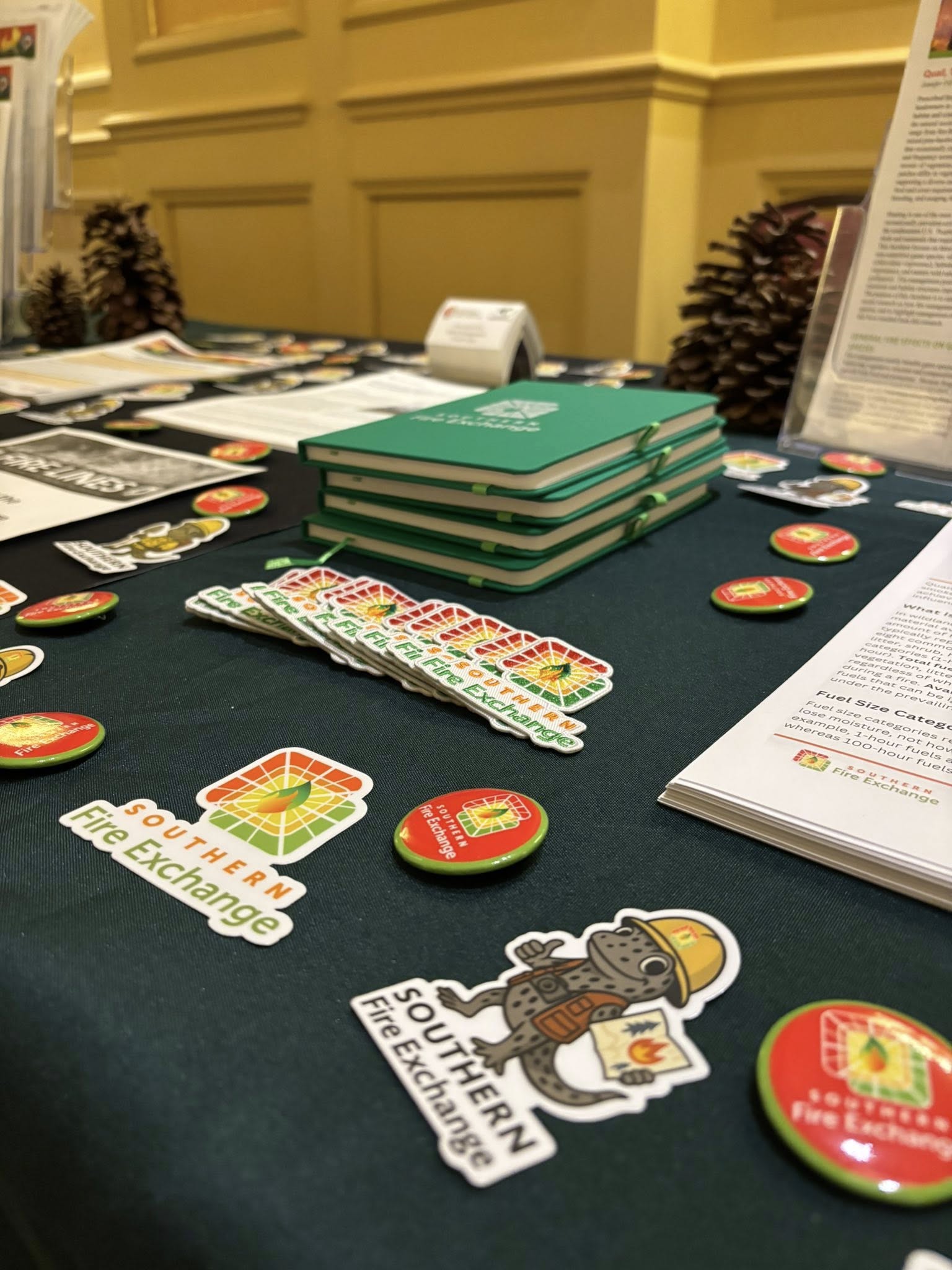
Southern Fire Exchange’s exhibitor booth at the Southeastern Association of Fish and Wildlife Agencies 79th Annual Meeting in Biloxi, MS. Stickers of Cinder the Salamander, Southern Fire Exchange’s mascot, can be seen alongside a variety of other merchandise and resources from the organization. Credit: Christian Fernandez
I bring up the valley of death, not for unnecessary poetry, but to emphasize the value of any person, program, or entity that seeks to build a bridge to cross it. 

The federal Joint Fire Science Program has funded wildland fire research for decades, but knew that in order to maximize their impact, they had to ensure the findings of that research would get into the hands of wildland fire practitioners. It was from this awareness that the Fire Science Exchange Network was born: a network of regional knowledge exchanges that would serve as bridges between wildland fire science and natural resource management.

The Southern Fire Exchange (SFE) was among the first, and serves 13 states across the southeastern U.S. Its perimeter loosely follows the historic range of longleaf pine, a pyrophilic species that declined dramatically because of widespread fire suppression. As such, much of the fire management in the southern region is centered around reintroducing and maintaining fire on the landscape, typically through prescribed and cultural burning. Despite historic fire suppression, the south is often regarded as the place that “never stopped burning”. Consequently, there is a thriving community of wildland fire scientists and practitioners across the region–each with their own wealth of knowledge. Since its conception, SFE has–in my biased opinion–done a fantastic job at bringing both communities in the same room, fostering co-production and peer-to-peer learning. But, there’s a group that hasn’t always been the most represented in our audience, and that’s the wildlife community.

I come from a background in wildlife and my experience made me acutely aware of the role fire has in wildlife management in the southeastern U.S. So, when I came to work for SFE, and noticed there was an opportunity to improve our outreach to wildlifers, I’ve since leaped over the proverbial valley of death at every chance I could.

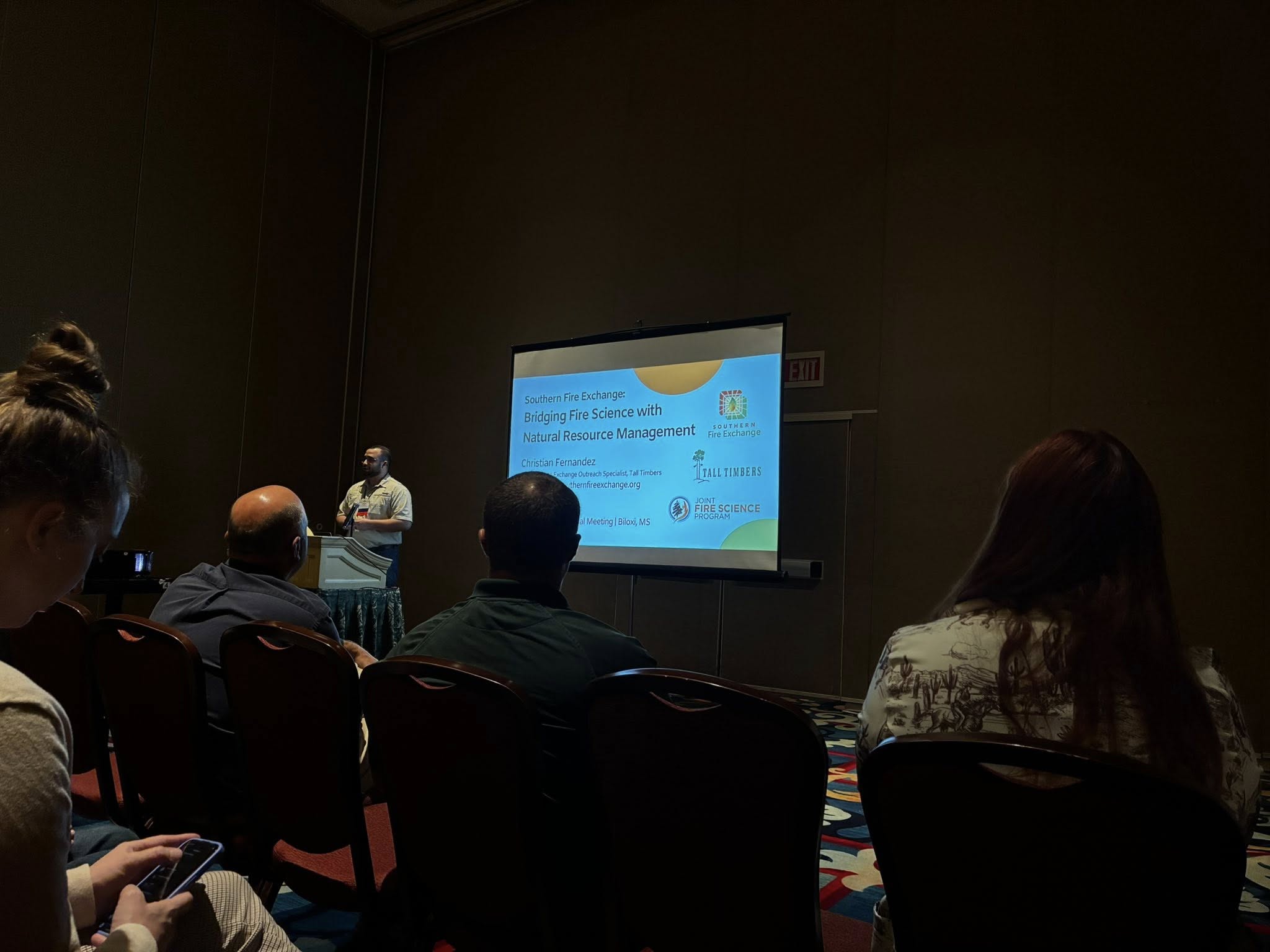
The latest leap was sponsored by the Association of Natural Resource Extension Professionals’ (ANREP) Travel Scholarship, which enabled me to participate in the Southeastern Association of Fish & Wildlife Agencies 79th Annual Meeting in Biloxi, MS. I gave a presentation on the programs and products of SFE to a packed audience and as an exhibitor, I had dozens of
Christian Fernandez, Southern Fire Exchange outreach specialist, presents on relevant programs and products from his organization to an audience of wildlife professionals at the Southeastern Association of Fish and Wildlife Agencies 79th Annual Meeting in Biloxi, MS. Credit: Christian Fernandez
conversations with professionals who had a distinct need for wildland fire programming in their locale. For example, a conversation with a Georgia private lands biologist has led to SFE’s own products being considered as a potential subject of studying impact on private lands conservation. These experiences affirmed my recognition of the need to extend our reach to this community, and that my attendance at this conference was a concrete way to do so. Moreover, attending the conference grew me personally, granting me the opportunity to connect with peers and practice my skills as an outreach professional.

So, my sincerest thanks go to ANREP for helping me cross the valley of death. Here’s to many more leaps!