Ecological Landscape Design for Coastal South Carolina
Ecological Landscape Design for Coastal South Carolina
Maeve Snyder, North Inlet Winyah Bay National Estuarine Research Reserve; Brooke Saari, South Carolina Sea Grant Consortium; Kaitlyn Dirr, ACE Basin NERR/South Carolina Department of Natural Resources
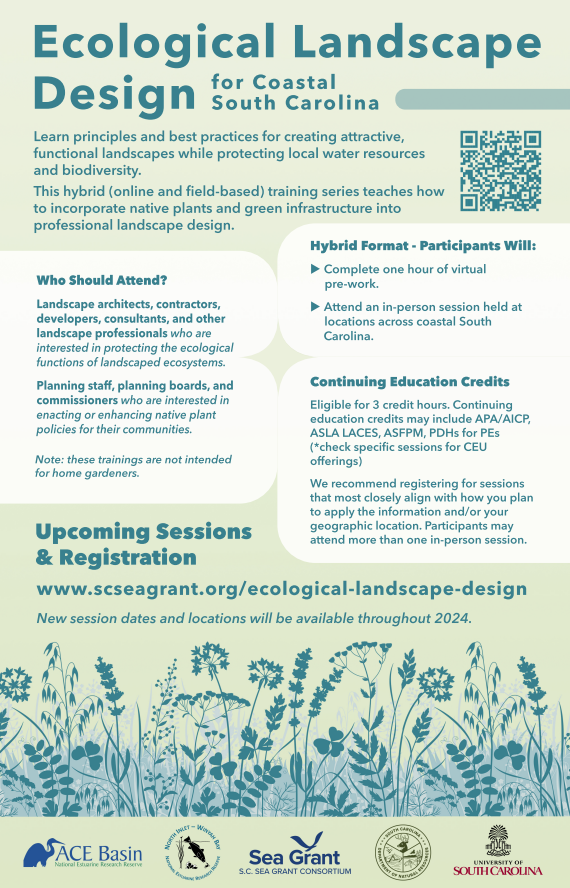 Throughout much of our programming around stormwater ponds and low impact development, it became increasingly clear that native plants were being left out of the landscape design conversations. Our program needs assessments were showing that there is a want from the homeowner and community side, but a lack of landscape designers that are actually incorporating into their plans. As well as, in some cases, a misunderstanding of native plants and their importance. In response to this issue, we put a program together that gave instruction but focused on real case studies and hands-on experiences. As well as trying to determine how to do a different type of program that we could still provide continuing education credits. That was how this innovative take on a hybrid style program came to be.
The North Inlet - Winyah Bay NERR, ACE Basin NERR, and the S.C. Sea Grant Consortium worked together to create a training series called "Ecological Landscape Design for Coastal South Carolina". This hybrid (online and field-based) training series focused on teaching how to incorporate native plants and green infrastructure into professional landscape design. The series was free and was eligible for three continuing education unit (CEU) credit hours for planners, landscape architects, state floodplain managers, and professional hours for engineers.
The main goal of the program was for participants to learn about principles and best practices for creating attractive, functional landscapes while protecting local water resources and biodiversity. The pre-recorded instructional videos and field-based experience learning objectives were to (1) recognize key principles about the benefits of native plants (2) gain familiarity with best management practices that are suited to landscaping and stormwater applications in coastal SC (3) Identify ways we can preserve, maintain, enhance, restore, or mimic ecosystem functions and services of the coastal SC landscape (4) understand key principles of design for creating functional ecosystems in 2 human landscapes, and (5) understand options for incorporating native plants in local policies.
The online part of the program focused on four short instruction videos from specialists in each topic area that served as the required pre-work for registered participants and provided one of the three CEU credits. These videos focused on benefits of native plants, landscape design, local policies for natives, and green stormwater infrastructure. In order to get credit for this part of the training course each participant had to attend at least one field experience date where they would fill out a quiz based on the video instruction.
The second part of this program was the field experience. The planning team scheduled two field trips in two locations along the coast that included onsite topic specialists and related case studies. Participants could attend one or more of the field trips to get their full CEU credits. Field trips included a) Hobcaw Barony that focused on LID and stormwater practices with a design activity and b) Charleston tour that focused on rain garden designs in a commercial setting and a community flooding buyout and mitigation program.
We had 32 people go through the course. All of the participants passed the quiz portion of the program and indicated that they enjoyed this style of instruction. Evaluation data indicated that everyone found the course useful and learned new things they plan to incorporate into their program. All attendees were able to specifically name aspects of the course that they felt most applied to their work, including techniques on low impact development, technical aspects of stormwater design, and examples they can refer to in the field.
Overall, this program was a success. We took a chance on this innovative take on a hybrid style program that was not a typical learning format, especially for CEUs. Not only were we able to address this issue with a target audience that we are not normally able to reach, but we proved that this alternative style programming could work in the right circumstances. We had positive feedback from speakers and participants on both portions of this program and plan to continue with even more field experiences moving forward. It was a unique take on a CEU course, targeted at the landscape professional.