Southern Fire Exchange's inaugural Pine Rockland Fire Science Workshop

By Christian Fernandez
Southern Fire Exchange Outreach Specialist
Tall Timbers Research Station


It's easy to picture Miami, Florida as a palm-filled, sandy paradise. But, what many don't realize is that Miami is home to one of the world's most unique and endangered ecosystems: pine rocklands. While savanna-like in structure, pine rocklands are unique in their exposed limestone caprock and the many, many potholes that form in it. This substrate serves as the foundation for unique evolutionary adaptations across taxa, resulting in dozens of endemic species of flora and fauna.


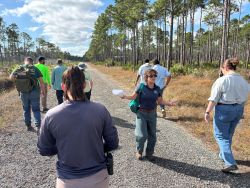
Simone Jimenez with Miami Dade County Natural Areas Management leads a field trip through Zoo Miami's pine rockland, discussing topics such as duff reduction, smoke management, and public communication about prescribed fire.
Pine rocklands are found along the Miami Rock Ridge in southeast Florida, the Florida Keys, and several Caribbean islands. They are threatened for different reasons across their range, and in Miami the main threats are fragmentation and decades of fire suppression. Nearly all of Miami-Dade County, from Florida City to North Miami Beach, was once pine rockland, but because of urban development what's left are small, occluded parcels. Moreover, this fragmentation along with active suppression have resulted in these communities being denied one of the most critical components to their ecology: fire. As a result, natural resource managers are challenged to restore prescribed fire to natural areas that have faced decades of fuel accumulation and are deeply embedded within the wildland-urban interface.

In December 2024, the Southern Fire Exchange (SFE), a regional science communication program, held a scoping meeting with over 15 stakeholders from across the range of pine rocklands. There were at least 10 agencies represented, and despite the diversity of perspectives, there was large consensus over the needs of the community. While issues like staffing and funding were discussed extensively, they weren't directly addressable by SFE emphasis on directly (more on that later). But they brought up several topics that were, namely reintroducing fire into long-unburned forests, smoke management, public communication, and prescribed burning in the wildland-urban interface. Once we had these needs identified, we got to planning. Fast forward to February 2026, and we hosted the inaugural Pine Rockland Fire Science Workshop in Homestead, FL.

Over the course of the three-day workshop, participants learned the latest science related to duff management and prescribed fire reintroduction, connected with fellow natural resource managers and their lessons learned from working in the wildland-urban interface, and taught principles of communicating with the public about prescribed fire. Our philosophy in planning the curriculum involved multiple "touch points" of information. For example, although the first day focused on duff and reintroducing prescribed fire, discussions about the constraints of the wildland-urban interface and public communication took place. Since the second day's materials focused on lessons learned from the wildland-urban interface and public communication, folks could draw on the context provided to them from the previous day. In addition to these "touch points," we catered to multiple learning styles with presentations, panel and small-group discussions, and field tours. Each of these activities reinforced the information taught in the others, offering a robust and comprehensive learning experience.


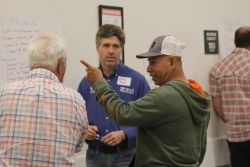
Participants of Southern Fire Exchange's inaugural Pine Rockland Fire Science Workshop engage in lively discussion during a small group exercise about reintroducing prescribed fire into long-unburned forests.

Participant commentary and evaluation data revealed that, not only were the workshop's learning objectives met, but its impact went beyond the classroom. Partners from multiple agencies and NGOs indicated strong intent to collaborate on developing a future Miami-Dade prescribed fire festival. A local Extension specialist was inspired by the workshop to make prescribed fire a significant part of his programming. And, if you remember the issue of staffing and funding earlier, this workshop helped facilitate the formation of new inter-agency partnerships that will increase capacity for prescribed burning in the region.

This workshop not only underscores the importance of workshops in sharing scientific information to support land management, but in fostering the relationships that are necessary to carry that information into action.