For many forest landowners, active forest management involves some level of biomass removal. Recall that biomass is defined as "the living or dead weight of organic matter in a tree, stand, or forest; and the wood product from chipping of unmerchantable trees, limbs, tops and slash." Unfortunately, in California there is a deficit of local places to take biomass for energy or other products, leaving many landowners wondering what to do with excess biomass from their management activities. Most of our landowners are familiar with piling and burning excess woody debris. In fact, of the forest management activities recommended by Registered Professional Foresters who visited our forest stewardship workshop participants’ forestry properties, piling and burning was the 3rd most frequently recommended after forest thinning and broadcast burning. Many of our workshop participants have been asking whether biochar creation could be an additional tool in their management toolbox to help get rid of excess biomass and create something of value.
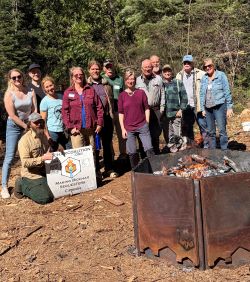
Participants at a biochar demonstration field day in Twain Harte, CA. Photo by Kim Ingram, UC ANR
There are many unanswered questions around biochar. However, there is a lot of research being conducted around effective and efficient biochar methods, scalability to larger forests, implications on forest health including soils, carbon storage capabilities, and markets just to name a few. The UC ANR Forest Stewardship Education Team, along with the Central Sierra Woody Biomass and Forest Products Advisor Cindy Chen, and in collaboration with the Biochar Coalition, recently hosted a biochar education webinar to share information on biochar products, markets, barriers and current research. We hosted two field trips to demonstrate the Ring of Fire (a small portable kiln to create biochar) and discuss practical applications for small forest landowners and managers.
Evaluation results showed an increased level of understanding (some or a lot of knowledge) of the science behind biochar creation and uses in webinar participants from 44% before the webinar to 63% after the webinar.
100% of the field day participants rated the event as very good or excellent. Comments included:
• “Lots of interesting discussion on different uses and perspectives.”
• “I’m looking forward to doing this (biochar creation) myself!”
In addition, we developed a newsletter to provide foundational knowledge on biochar basics, soil interactions, project considerations, economic considerations, and a Q&A with a landowner who has been producing biochar from woody debris on his forest and applying it to his vineyard and vegetable garden.
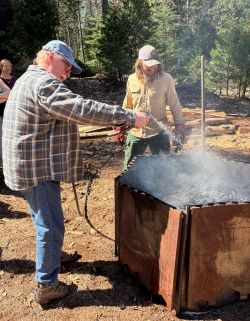
Workshop participant dousing the flames in the Ring of Fire. Photo by Kim Ingram, UC ANR